Bridge Pose (Setu Bandhasana): Your Gentle Heart Opener and Back Strengthener
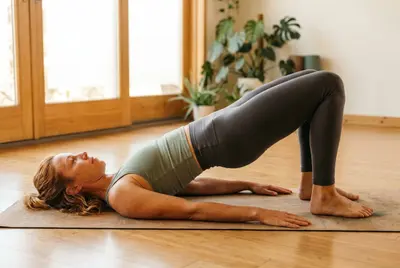
Bridge is the pose to reach for when your back is tired. Not sore, tired: the dull ache that comes from a day in a chair. Lifting the hips off the floor asks the back of the body to work, opens the front of the hips that sitting shortens, and does both without any strain on the neck if you set it up properly.
It is also the first backbend most beginners do, and a good one to learn on, because the floor does half the job. Your shoulders and feet stay planted. The only thing that moves is the middle.
One honest thing: the first few times, your hamstrings may cramp. That is not damage, it is a muscle being asked to do something new. Lower down, shake the legs out, and try again with the feet a little closer to the hips.
How to do it
- Lie on your back with your knees bent and your feet flat. Feet hip-width apart, close enough to the hips that you can just brush your heels with your fingertips. Arms alongside you, palms down.
- Press the whole foot into the floor, big toe included. This is the cue that saves knees. If the weight rolls to the outer edge of the foot, the knees splay and the lower back takes over.
- Breathe out and lift the hips. Start the lift from the tailbone, not the belly. Come up until the thighs are close to parallel with the floor, and no higher than feels easy today.
- Keep the knees pointing straight ahead. Imagine holding a block between the thighs. If they drift wide, squeeze them back in.
- Leave the neck alone. Look straight up, not at your knees. The chin can tuck a little on its own, but never turn the head while you are up.
- Choose your arms. Press them into the floor for support, or roll the shoulders under and interlace the fingers beneath you. The interlace lifts the chest higher and asks more of the shoulders.
- Hold for five to eight slow breaths. Breathe into the front of the ribs. Notice the glutes working and the front of the hips opening.
- Breathe out and lower one vertebra at a time. Upper back first, then the middle, then the hips. Rest with the knees together for a breath before the next round.
Make it easier, make it deeper
If holding the hips up is hard, put a block or a firm cushion under the sacrum, the flat bone at the base of the spine, and let the hips rest on it. This is Supported Bridge, and it is restorative rather than strengthening. Two or three minutes there feels like a reset.
If the knees will not stay in line, hold a block between the thighs. Squeezing it teaches the inner thighs to help.
If the neck feels pinched, skip the shoulder roll and keep the arms flat on the floor. A folded blanket under the shoulders, with the head off the edge of it, also takes pressure off the neck.
To go deeper once eight breaths feels easy, lift one foot off the floor and extend that leg to the ceiling for three breaths, then switch. Keep the hips level. This is Single-Leg Bridge, and it finds every lazy glute.
What I watch for
The commonest mistake is lifting too high. People push the hips to the ceiling, the lower back pinches, and the ribs flare. The pose does not get better with height. It gets better with the thighs staying parallel and the glutes doing the work. If you feel it in the lower back and not in the back of the legs, come down an inch.
The second is the feet. When the heels are too far from the hips, the hamstrings cramp. When they are too close, the knees push past the ankles. Brushing the heels with the fingertips is the right distance for most bodies.
The third is holding the breath. Backbends make people brace. Keep the exhale long, and let the lift rise and fall a little with each breath.
Where it fits
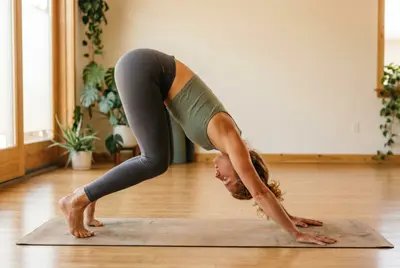
Bridge is fourth in the foundation sequence, after Downward-Facing Dog has warmed the back of the legs and before Cobra Pose, which asks for a deeper bend in the upper back. Two or three rounds of five to eight breaths is plenty. Done on its own after a long day at a desk, one round of Supported Bridge is enough to change how the back feels.
Try it tonight, on the floor, before you sit down again.
Last updated