Mountain Pose (Tadasana): Your Grounding Foundation in Yoga
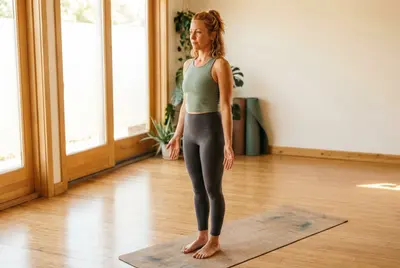
Mountain Pose looks like standing still, and that is why most people skip it. It is the pose most worth your time as a beginner, because every standing pose after it borrows its feet, its legs, and its spine.
It is also the easiest place to notice how you actually stand. Most of us lean into one hip, lock the knees, and let the chest drop. Tadasana undoes all three in under a minute.
One honest thing: done properly, it is more work than it looks. Your thighs and belly should be quietly busy the whole time.
How to do it
- Stand with the feet hip-width apart and parallel. Big toes may touch, heels slightly apart, if that feels steadier.
- Spread the weight across the whole foot. Rock forward and back once, then settle in the middle. Lift and spread the toes, then set them down.
- Lift the kneecaps without locking the knees. A small squeeze of the thighs, not a brace.
- Let the tailbone drop and the lower belly draw in. This lengthens the lower back rather than arching it.
- Lift the chest and widen the collarbones. Shoulders roll back and down, away from the ears.
- Turn the palms to face forward. This rotates the arms open and takes the chest with it.
- Lengthen the back of the neck and soften the gaze. Imagine a thread from the crown of the head to the ceiling. Breathe for five to ten slow breaths.
Make it easier, make it deeper
If balance is shaky, stand with your back an inch from a wall, or take the feet a little wider. There is no prize for big toes touching.
If your knees tend to lock back, keep a small bend in them until you can feel the thighs lift the kneecaps on their own.
To make it harder, close your eyes. Balance gets less certain without sight, and the feet have to do more of the work. Stay near a wall the first time.
You can also raise the arms overhead, palms facing each other, without letting the ribs flare forward. That is Upward Salute, and it is how many sequences move out of Mountain.
What I watch for
Locked knees come first. Pushing the knees straight back feels stable but puts the load into the joint. Lift the kneecaps with the thighs instead, and let the knees be straight but soft.
Then the lower back. People hear “stand tall” and puff the chest, which arches the lower back and tips the ribs forward. Let the tailbone drop and the lower belly draw in, and the chest will lift on its own.
Last, the shoulders. They creep up towards the ears whenever you concentrate. Every few breaths, let them fall.
Where it fits
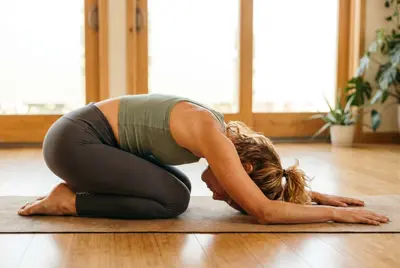
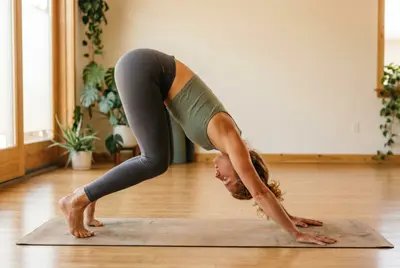
Mountain is first in the foundation sequence. Take five to ten slow breaths here, then kneel and fold into Child’s Pose before moving to Downward-Facing Dog. Come back to it between standing poses whenever you lose your footing.
You can practise it anywhere: in a queue, at the kettle, waiting for a train. Nobody will notice, and your back will.
Last updated