Cobra Pose (Bhujangasana): A Gentle Backbend for a Quieter Mind
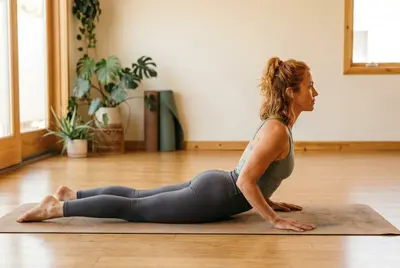
Cobra is for a spine that has been folded forward all day. Hours at a desk, over a phone, or behind a wheel round the upper back. Cobra reverses that, gently, and opens the chest so the breath has somewhere to go.
One honest thing: most people push up with their arms and feel it in the lower back. The lift in Cobra comes from the back muscles, not the hands, and it is lower than you expect. If your arms are doing most of the work, you have gone past the pose.
Why it works
Cobra restores movement to the spine. Lying on your front and lifting the chest bends the upper and middle back in the direction they rarely go, which eases the stiffness of long sitting.
It opens the chest and the front of the shoulders. With the ribs free to move, the breath gets deeper without any effort to make it so.
It strengthens the back. The muscles along the spine do the lifting, and with the legs pressing down, the lower back is supported rather than squeezed.
Done slowly, with long exhales, it is also calming. Many people find a few slow rounds of Cobra quieter than they expected from a backbend.
How to do it
- Lie on your front with the tops of the feet pressing down. Legs straight back, hip-width apart. Rest the forehead on the mat and take a few breaths.
- Place the palms under the shoulders. Fingertips point forward, elbows hug in close to the ribs.
- Press the tops of the feet, the thighs, and the pubic bone into the floor. Draw the lower belly gently in. This is the base that protects the lower back.
- Breathe in and peel the head and chest off the floor. Lead with the breastbone. Use the back muscles to lift and the hands only to steady you.
- Stop where it is still easy. For most beginners that is Baby Cobra, with the elbows bent and the forearms close to the floor. Keep the elbows soft even if you lift higher.
- Draw the shoulders down and away from the ears. Keep the back of the neck long and the gaze a little forward, not up at the ceiling.
- Hold for three to five breaths. Feel the chest widen on each inhale. Check that the jaw is soft and the glutes are working without clenching.
- Breathe out and lower slowly. Chest, then chin, then forehead. Turn the head to one side, rest the arms alongside you, and take a few breaths before the next round.
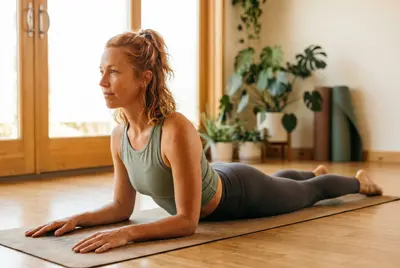
Make it easier, make it deeper
Sphinx Pose is the easier version. Rest on the forearms with the elbows under the shoulders and let the chest lift a little. It is gentle on the lower back and on the wrists, and a good place to start.
To go deeper, try Twisting Cobra. From the lifted position, turn the chest and gaze to look over one shoulder, then the other. It stretches the sides of the torso.
Or try Dynamic Cobra: lift on each inhale and lower on each exhale for five or six rounds. Moving with the breath like this is one of the calmest ways to use the pose.
What I watch for
The biggest one is pushing with the arms. If the elbows are straight and the lower back pinches, come down until the back muscles can hold you. Try lifting the hands off the mat for a breath. Whatever height you can keep is your Cobra today.
The second is shoulders creeping up. As the chest lifts, the shoulders often rise to meet the ears. Roll them back and down and let the collarbones widen.
The third is cranking the neck back. Looking at the ceiling pinches the back of the neck. Keep the gaze forward and let the neck continue the line of the spine.
Where it fits
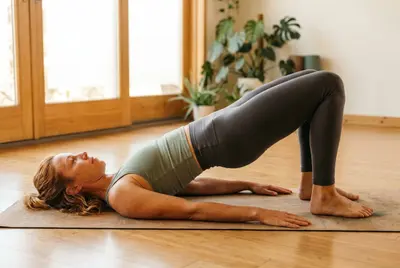
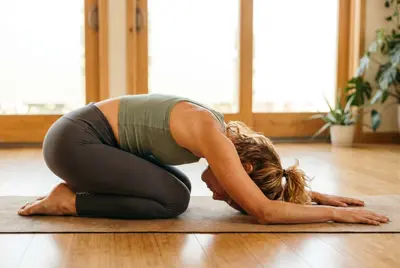
Cobra is fifth and last in the foundation sequence, after Bridge Pose has warmed the back. Two or three rounds of three to five breaths is plenty. Rest afterwards in Child’s Pose to let the lower back lengthen again.
Check the “skip or modify” list at the top of the page before you start, because Cobra is not for every body every day. Always listen to your body. If you feel any sharp pain, gently release the pose.
A low Cobra done with your back will do more for you than a high one done with your arms.
Last updated